
I’ve written a more plain language introduction elsewhere, but for those with a deeper interest in astrology as a subject, this page goes into a bit more technical depth and detail on my astrological approach.
Blending modern and ancient astrology in theory
I practise a blend of modern, psychological astrology and ancient, especially Hellenistic, astrology.
Hellenistic astrology is around 2,000 years old, and built upon practices developed over centuries of previous observation and practice in ancient Mesopotamia. I value the theoretical richness and technical complexity of the ancient astrology, which was created by the intellectual elite of its day.
Much of this was lost to mainstream practice, languishing untranslated, as dogmatic forms of Christianity historically led to the criminalisation of ‘fortune-telling’, and scientistic ways of viewing the world came to prominence. When the geocentric worldview was shown to be incorrect from an objective point of view, astrology was no longer aligned with the science of its day, and this contributed to its decline.
However, the 20th century also brought significant advances in person-centred approaches and understanding the psyche. In particular, Carl Jung’s work on the internal dynamics of the psyche and its interplay with collective psychic forces has undeniable application for astrology.
At the same time, Carl Rogers’s humanistic approach centres the empowerment that self-discovery and insight can bring for personal growth, which also resonates powerfully with astrology.

Blending modern and ancient astrology in practice
In practice, I use ancient techniques, such as profections, traditional rulerships, sect and Lots, while the philosophical framework of my practice is a modern, Humanistic one in which the owner of the birth chart is the expert in their own life. I believe that, while the birth chart shows that each of us has a fate, we also have meaningful choices.
Informed by evolutionary astrology and a belief since childhood in reincarnation, I also believe that we have a soul and the birth chart shows us areas of development in this lifetime as well as some indications of psychic burdens we have carried since before birth.
However, belief in reincarnation is not essential, because the chart also shows our childhood and attachment patterns, so astrology works very well with principles of depth psychology alone.
I use Whole Sign Houses as primary and often also Placidus as an overlay. I find that Whole Sign Houses is very effective for predictive work, perhaps due to its relatively objective structure (whereas Placidus has a more time-based symbolism that is rooted in the place of birth). I do not make concrete predictions, however, and instead focus on archetypal prediction.
Because of its systematicity, Whole Sign Houses works very well with rulership, even for people born at latitudes and seasons where quadrant-based house systems can seriously distort the chart and its rulership structure. Treating the planets as rulers gives added nuance to transits and houses, as well as layers of information for ’empty’ houses.
I use the tropical zodiac, although I believe the sidereal zodiac works just as well. Although house systems can be overlaid and used together, this is not the case for zodiacs and it is better to use one consistently. For me this is tropical, which is somewhat more geocentric and with more seasonally-influenced symbolism, as well as the one I’m familiar with.
Using prediction in astrology in a supportive way
I know some modern astrologers prefer to use astrology only for personal understanding and insight, and I respect that. I have an offering that is entirely focused on self-understanding, which is suitable for people who are wary of prediction for any reason, as well as those who are having their chart read for the first time.
However, I do work predictively. I don’t predict concrete, specific events and outcomes. This is because I see astrology as archetypally predictive. This means that the symbolic language of astrology tells us the patterns and shapes of events on earth, which can manifest in unique ways in our actual lives. I also think this is a more empowering way to look at it.
In the past, I have experienced interpreting transits and getting overly focused on hopes of a particular manifestation, and remembering this keeps me humble. It’s important to keep an open mind, and not presume to know the mind of the universe. I have an article elsewhere about prediction in astrology, for more information on my view of this.
With conscious awareness of the archetypal patterns, we can learn to accept ourselves and our own unique way of being, and work to shape our life direction. If we know the shape of things to come, we can work with the forces of change to influence how they manifest.
Becoming conscious is not about controlling anything, but accepting and working in partnership with the universe, including our own shadow.
My methods of predictive work
I most routinely use a blend of transits, secondary progressions, annual profections and solar (and sometimes other planetary) returns. In this way, I use some methods drawn from Hellenistic astrology combined with psychological principles in my interpretations.
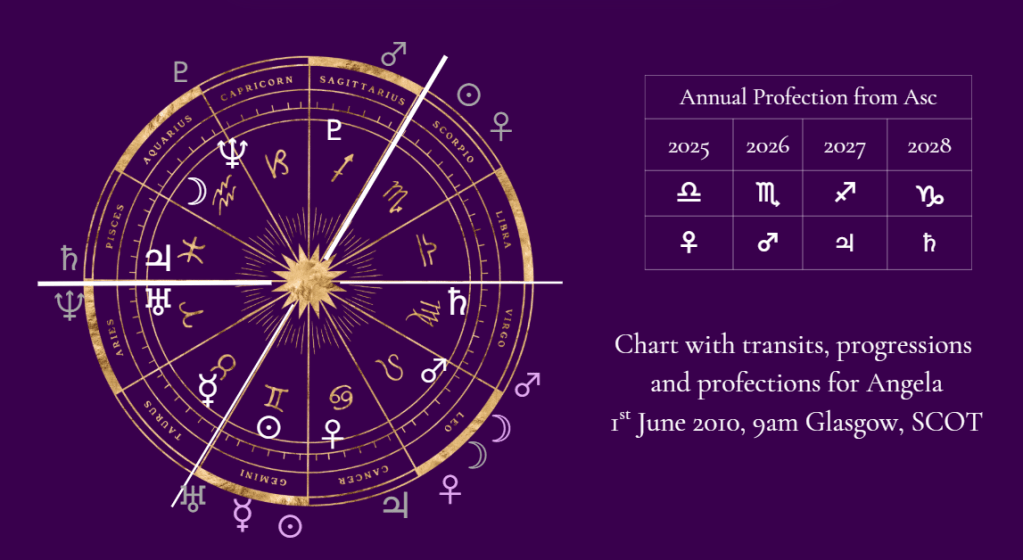
I work with the outer planets, although I don’t use modern rulerships, which for me do not fit with the integrity of the original system of structured inter-relationship. I don’t equate the houses directly with the signs, although admittedly there may be some degree of resonance – I regard these as a distinct 12-fold system.
I’m fascinated by the astrology of transitions and, in particular, those of mid-life (broadly defined as ages 35-60), as well as Saturn cycles in general and how these intersect with secondary progressions.
There are ancient methods of dividing the lifetime which are very effective, and for example I sometimes weave in methods like firdaria. (This is a medieval planetary periods technique which assigns a ruling planet for a number of years associated with that planet.)
However, I find the outer planet transits from Jupiter, Saturn and Chiron out to Pluto offer huge insight into a sequential development. Although the order of the transits shifts slightly with the generations (due to the elliptical orbits of Pluto and Chiron), the processes are largely consistent. They offer a reliable indicator of key rites of passage and understanding how this connects with the natal chart yields valuable insights.
I offer discounted readings to other astrology students and professionals. Click to book a consultation or make an enquiry.
 Heliodora